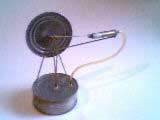
Don't throw away that tin can! Built with a soldering iron and less than $10
worth of parts, the HK-1 Stirling engine is fun to build.
Download
free ebook
-or-
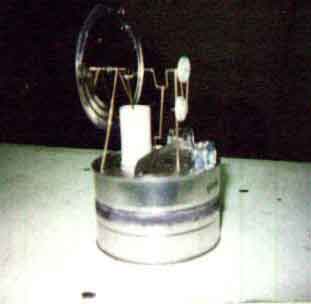
HK-2 Plans not available but it can be built using the same
techniques.
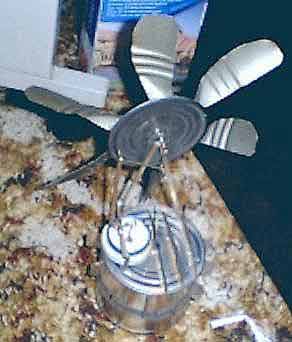
HK-3
Solar Powered Fan
This engine has a complex lever arrangement to make use of a rubber diaphragm
instead of a piston. The blades are very sharp and dangerous so I have not
published the plans.
If you have any homebuilt model engine pictures of your own, please send them in!

"Amazingly simple model stirling engine plans! Other stirling engine plans may require a machine shop. These engines are easily made from tin cans using a soldering iron and simple hand tools."
Build this excellent teaching aid and science fair project today!
Download free ebook
Stirling is the correct spelling, by the way. I used to think they were spelled "sterling engines." (I could probably get away with calling my engines sterling engines because I lived near the town of Sterling, Alaska.) Nevertheless, Stirling engines are named after their inventor, Robert Stirling.
Some information sources out there confuse ordinary heat engines with
stirling engines. Stirling engines, unlike other heat engines, use a regenerator,
which recycles internalenergy (heat) many times. Feel free to browse the
illustrations, but the best way to learn how stirling engines work is to
build one!
 How does it
work? View a
How does it
work? View a
larger animated
illustration.
Please comment, rate, and subscribe to our YouTube channel.
What I like about Stirling engines:
Double-action piston: It is a true one-stroke engine, since the piston both pushes and pulls, delivering smooth power on every stroke. A car engine, on the other hand, is a 4-stroke (or, in rare cases, a 2-stroke) engine. It only delivers rough, explosive power on every 4th stroke. As a result, car engines wear out much quicker and produce more noise.
Simple design: There are no spark plugs, coils, wire, points, injectors, valves, camshafts, oil sump, pumps, filters, carburetor, mufflers or timing belts/gears to wear out.
Efficiency: With modern designs and materials up to the maximum theoretical thermodynamic efficiency is possible because of the way heat is recycled many times inside the engine instead of used once and thrown away as in conventional engines.
They will run on almost any fuel: Power may be the heat of a candle or concentrated sunlight. Some carefully-built models can even run on the heat from warm hands. They will also run on chemical processes that produce cold instead of heat. I was able to run the HK1 at great speed on liquid nitrogen until the oil became hard and brittle (next time I'll use graphite).
Quiet running: At maximum power all that can be heard is slight whirring or clanking and only then if the bearings are loose. I've witnessed engines that run totally silent and are even compensated for vibration.
Safety: Stirling engines are probably the safest engine to work with. They can't explode like steam engines and the models on this page don't really put out enough power to injure anyone. I suppose sunburn is possibble (when setting up a solar engine) and solering irons are hot. Use adult supervision!
Innovative potential: Old-style stirling engines did not perform nearly as well as their internal combustion cousins. Their low power-to-weight and power-to-size ratios made them unreasonable candidates for automotive power plants. There were a few attempts at powering automobiles with stirling engines but consumers wanted more 'pep'. Stirling engines can often take several minutes to warm up & deliver useful power. With space-age materials, however, the stirling engine is freed from these limitations. Stirling HEV's may be the transportation of the future..
Download the free ebook.
Subscribe to our Energy Newsletter (new)
